

 Cybercrime is no longer a loose collection of hackers, tools and opportunistic attacks. As we move into 2026, it has matured into a highly industrialized ecosystem—complete with specialization, automation, affiliate networks, and even cartel-like business models. The result is a threat landscape defined by speed, scale and sophistication, where attackers adapt faster than traditional defenses can respond.
In this post we’re looking at the trends shaping cybercrime in 2026, which are the logical next step of patterns that accelerated throughout 2024 and 2025. Understanding these shifts is essential for organizations that want to stay resilient and secure in the year ahead.
Cybercrime as an industry, not an activity
One of the most defining characteristics of cybercrime in 2026 is its industrial structure. Modern attacks are rarely carried out end-to-end by a single group. Instead, they rely on a supply chain of specialists:
- Initial Access Brokers selling stolen credentials or network footholds
- Malware loaders-for-hire delivering payloads on demand
- Negotiation teams managing extortion and ransom payments
- Professional money launderers cashing out proceeds
This “cybercrime gig economy” allows attackers to scale operations dramatically. Ransomware groups can now move from initial compromise to full extortion in days—or even hours—by outsourcing each phase to experts. The outcome is a fragmented but highly efficient ecosystem that produces more attacks, at higher velocity with lower operational risk.
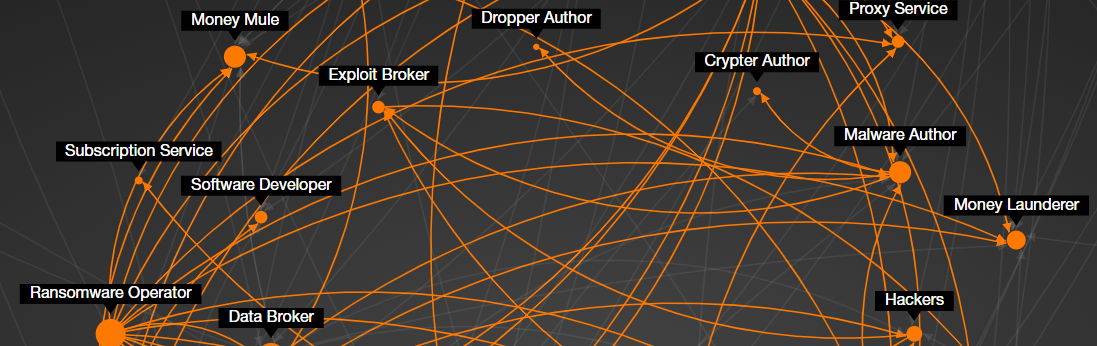
Partial view of the criminal ecosystem from a cyber extortion point-of-view, via Orange Cyberdefense
Affiliate models drive volume, private crews chase value
Ransomware-as-a-Service (RaaS) dominates the threat landscape in 2026, largely because the model is so resilient. When a RaaS operation is disrupted, affiliates simply move to the next platform. The attack volume may decline for a short time, but the ransomware ecosystem can absorb law-enforcement pressure with minimal long-term impact.
Some groups have adopted cartel-style models that offer generous revenue splits, white-label branding and shared infrastructure to attract top talent. See our profile on DragonForce Ransomware Cartel for an example.
Other groups like Sinobi are closed, invitation-only crews that target fewer victims with higher-value outcomes. These groups avoid public recruitment, focus on their own purpose-built tooling and often pursue “big game” targets where a single successful breach can yield enormous returns.
The result is an increasingly hybrid threat landscape in 2026:
- High-volume ransomware and extortion campaigns driven by affiliates and cartels
- Low-volume, high-impact intrusions carried out by private, highly skilled teams
Attacks are faster and quieter
Speed is now one of the most dangerous weapons in a threat actor’s arsenal. Attack timelines that once measured in weeks are now compressed into days, hours, or even minutes. In some cases, data theft and extortion are completed before defenders can meaningfully respond.
At the same time, attackers are getting better at reducing noise. In 2026, we expect continued growth in encryption-less extortion, where criminals steal sensitive data and threaten exposure without deploying ransomware (encryption) at all. These attacks avoid the operational disruption that triggers emergency response while still applying maximum pressure through data leaks.
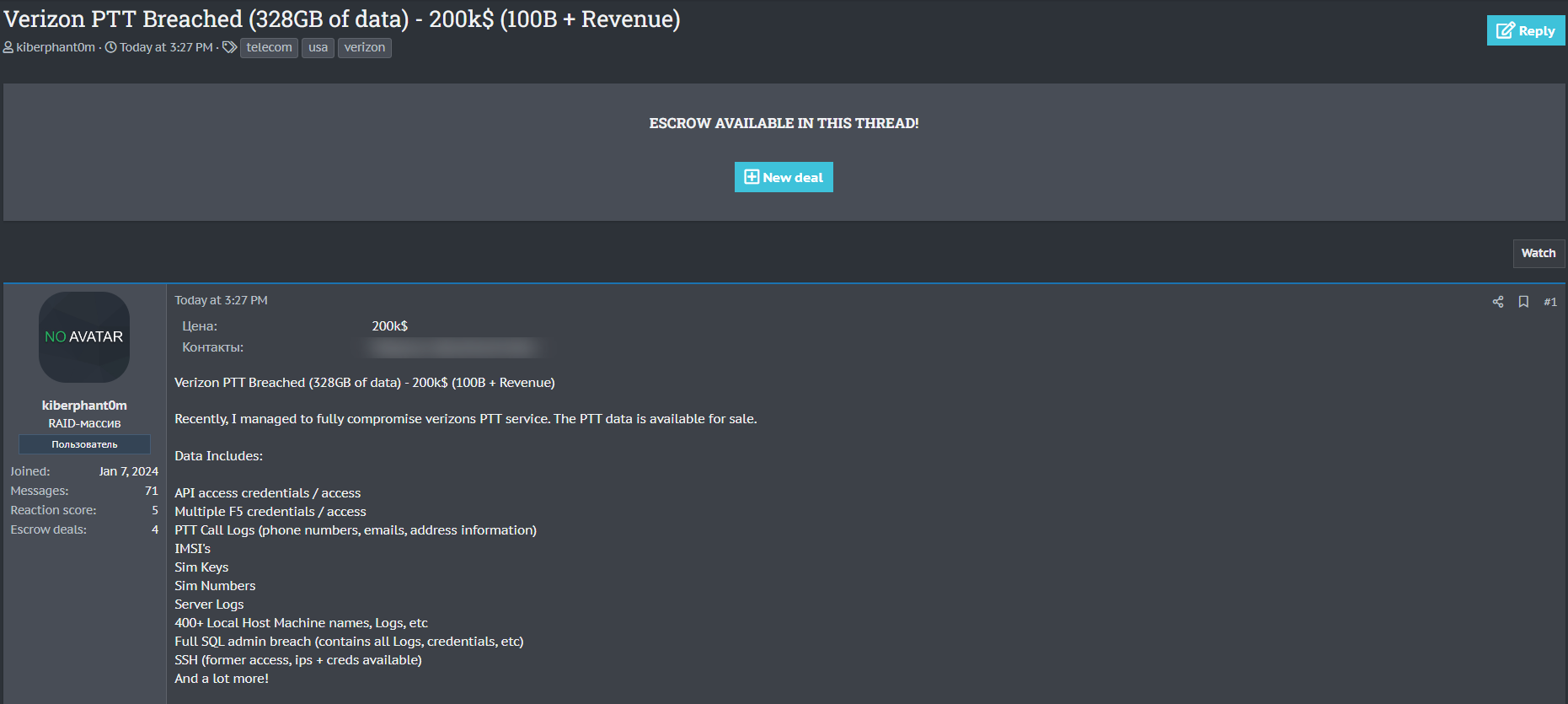
Forum post offering Verizon data for sale. Cameron John Wagenius operated online under the alias “kiberphant0m” and worked alongside co-conspirators to break into corporate networks and steal sensitive data. Full story and more images at Dark Web Informer.
To stay hidden, threat actors increasingly rely on:
- Living-off-the-land techniques using native admin tools
- Fileless and in-memory malware
- Abuse of legitimate but vulnerable drivers to disable defenses
The goal is simple: blend in, move fast, and stay invisible until it’s too late.
AI becomes a force multiplier for attackers
Artificial intelligence (AI) is reshaping the entire attack lifecycle. In 2026, attackers are expected to deploy AI-augmented and semi-autonomous malware capable of:
- Scanning environments and identifying weaknesses
- Selecting exploits dynamically
- Adjusting tactics in real time when defenses are encountered
On the social engineering front, deepfake audio and video are pushing fraud into new territory. Voice cloning and realistic AI-generated personas make identity verification far more difficult, particularly in financial and executive-targeted scams.
Defenders are also adopting AI-driven security tools, and AI vs. AI skirmishes will increase through the next year. The challenge for defenders is that attackers only need to succeed once, while defenders must be right every time.
Related: Frontline security predictions 2026: The battle for reality and control in a world of agentic AI
Criminal and nation-state threats continue to converge
The boundary between cybercrime and nation-state activity is increasingly blurred. Financially motivated attacks, espionage, hacktivism, and geopolitical disruption now overlap in ways that complicate attribution and response. For example, Lazarus Group operations are directed by the state, but the group will use non-Lazarus infrastructure and other resources as needed.
Nation-states are:
- Leveraging criminal infrastructure and access brokers
- Running ransomware and data theft operations to fund strategic goals
- Allowing or encouraging hacktivist groups to act as deniable proxies
Related: Lazarus Group: A criminal syndicate with a flag | Barracuda Networks Blog
At the same time, criminal groups are adopting tactics once reserved for advanced persistent threats, including stealthy long-term access, supply-chain compromise and attacks on critical infrastructure.
For defenders, this means planning for incidents that may serve both financial and political objectives simultaneously. Defenders should build detection and incident response strategies that assume one intrusion could be used for short-term extortion and long-term espionage or disruption.
High-leverage targets remain in the crosshairs
While no sector is immune, threat actors consistently gravitate toward industries where downtime, safety, or regulatory pressure increases the likelihood of payment. Manufacturing, healthcare, energy, transportation, and financial services remain top targets heading into 2026.
Supply-chain attacks are also expected to increase. By compromising a single widely used platform or service provider, attackers can impact hundreds of downstream organizations in a single campaign—maximizing return while minimizing effort.
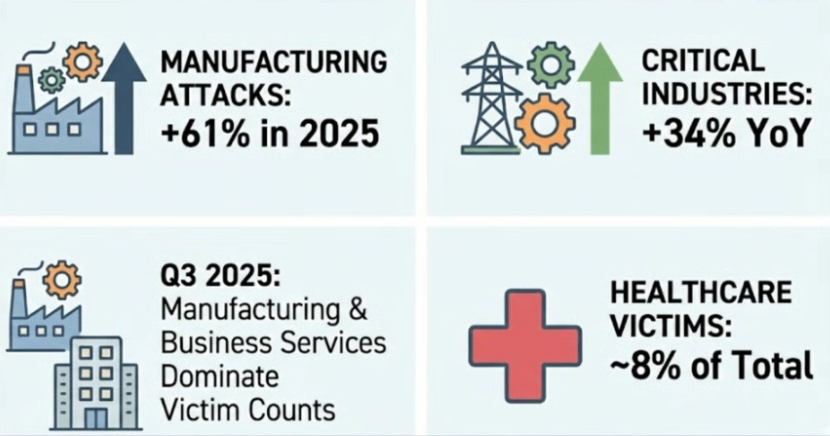
Summary of Top industries targeted by ransomware actors in 2025, via SOCRadar.
What this means for 2026
Industrial efficiency, extreme speed, AI-driven automation, and blurred motives define the cybersecurity landscape in 2026. Attackers are operating like mature businesses, continuously optimizing for scale, profitability, and resilience against disruption.
For organizations, this means:
- Assuming breaches will happen faster than human response alone can manage
- Prioritizing identity security, credential protection, and visibility across environments
- Preparing for extortion scenarios that do not involve ransomware (encryption) at all
- Treating cyber risk as both a business and geopolitical concern
Cybercrime is no longer evolving year by year—it is iterating continuously. The organizations that succeed in 2026 will be those that recognize this reality and adapt just as quickly.
Maximize your protection and cyber resilience with the BarracudaONE AI-powered cybersecurity platform. The platform protects your email, data, applications, and networks, and is strengthened by a 24/7 managed XDR service, unifying your security defenses and providing deep, intelligent threat detection and response. Manage your organization’s security posture with confidence, leveraging advanced protection, real-time analytics and proactive response capabilities. Robust reporting tools provide clear, actionable insights, helping you monitor risks, measure ROI and demonstrate operational impact. Don’t miss the opportunity to get a demo of the platform from our cybersecurity experts.
Photo: tete_escape / Shutterstock
This post originally appeared on Smarter MSP.